Educational technology in Indonesia is undergoing a massive transformation to expand access, improve quality, and improve efficiency through e-learning platforms, blended learning, and interactive devices such as Interactive Flat Panels (IFPs). This is addressing geographic disparities by reaching remote areas. However, it faces challenges in infrastructure, teacher training, and digital literacy, requiring collaboration between the government and institutions for equitable and optimal implementation in support of the Golden Indonesia 2045 vision. Current technological developments have transformed almost all aspects of life, including education. The current learning process must adapt to the Industry 4.0 era because in this era, technology is merging to combine physical, biological, and digital dimensions, making it difficult to distinguish between them. The use of technology in education has both positive and negative impacts. Integrating technology into education can increase active student participation, facilitate broader access to information for both students and educators, and enhance students' creativity and critical thinking skills. Information and communication technology continues to develop rapidly, changing the way humans work, interact, and learn. In education, technological advances provide various resources that can expand access to knowledge, improve teaching effectiveness, and create a more interactive learning process. This technology encompasses various features such as natural language processing, machine learning, object recognition, and automation systems that are now used in various sectors of life. Students can access information more quickly, gain a personalized learning experience, and adjust the learning process to individual needs. In relation to an individual's personal life, it is a life that is whole and complete and has special or unique characteristics. A person's personal life encompasses various aspects, including emotional, socio-psychological, socio-cultural, and intellectual abilities, which are integrated with environmental factors in their life. It is viewed as a whole and complete in the form of stable behavior and actions. Thus, personal life issues are a form of integration between physical, socio-cultural, and psychological factors. An individual also needs recognition from others regarding his or her self-worth, both from his or her own family and from society. The influence of adolescence as a student, coupled with the dynamic use of technology in modern education, has proven to support student success in the educational process. However, innovation and creativity are needed from all stakeholders in Indonesia, particularly in higher education.
This is an Open Access article, distributed under the terms of the Creative Commons Attribution 4.0 International License (http://creativecommons.org/licenses/by/4.0/), which permits unrestricted use, distribution and reproduction in any medium or format, provided the original work is properly cited.
Education Technology, World of Modern Education, Development of Life, Adolescence, Indonesian Student
1. Introduction
Technology has opened up new opportunities to improve access and quality of education, but it also presents its own challenges. The development of technology in education in Indonesia can be seen in the increasing use of digital devices and e-learning platforms. Agustina stated that the use of technology in learning can improve the quality of learning through access to a wider and more varied range of learning resources. Technology also enables more interactive and collaborative learning, thereby increasing student motivation and participation in the teaching and learning process. Furthermore, technology also enables personalized learning, where students can learn according to their own pace and learning style
[1]
Agustina, R. (2018). Use of Technology in Learning. (Penggunaan Teknologi dalam Pembelajaran). Journal of Education, 12(3), 123-135.
[1]
. Educational technology in Indonesia is developing rapidly through the Ministry of Education, Culture, Research, and Technology's digitalization initiatives, such as the Merdeka Belajar platform, to increase inclusivity and quality of learning. The use of e-learning, interactive panels, and digital content helps reach remote areas. Despite its efficiency, the main challenge is the infrastructure gap, especially in the 3T (Frontier, Outermost, and Disadvantaged) areas.
However, the use of technology in education in Indonesia still faces various challenges. One of the main challenges is the digital divide between urban and rural areas. Budiarti revealed that access to technology in remote areas is still very limited, both in terms of infrastructure and internet access. This causes a gap in access to education between students in urban and rural areas. In addition, the lack of skills and knowledge of teachers in utilizing technology is also an obstacle in implementing technology in education
[2]
Budiarti, S. (2021). The Digital Divide in Indonesia: Challenges and Solutions (Kesenjangan Digital di Indonesia: Tantangan dan Solusi). Technology Journal, 15(1), 45-59.
[2]
. Today, needs have begun to shift to digital systems. Digital content, in the development of the digital ecosystem, is certainly supported by healthy internet behavior; these two are crucial and inseparable. The internet has opened doors to information, containing a wide range of content, both positive and negative. If we don't have the skills to utilize it, the internet will become a threat to its users
[3]
PaputunganF., & AgeS. (2023). THE USE OF DIGITAL MEDIA AND EDUCATIONAL TECHNOLOGY IN LEARNING, Frezy Paputungan, Sulastri Pua Age: THE USE OF DIGITAL MEDIA AND EDUCATIONAL TECHNOLOGY IN LEARNING, Frezy Paputungan, Sulastri Pua Age. Journal of Education and Culture (JEaC), 3(1), 1-8. Retrieved from
Adolescence is a rapid developmental transition phase from childhood to adulthood (usually 10-21 years old), marked by physical (puberty), psychological, and social changes. This phase is crucial for the formation of self-identity, the search for independence, and often unstable emotions. Adulthood is very interesting to study, first because it enters the longest age in the stages of human life, second, undergoing heavy and complex developmental tasks with various dynamics of physical and psychological problems as a result of previous development, third, the age of maturity in resolving life's challenges, fourth, How the Islamic concept views adulthood
[4]
PaputunganF. (2023). Developmental Characteristics of Early Adulthood: Developmental Characteristics of Early Adulthood. Journal of Education and Culture (JEaC), 3(1), 47-56.
. The purpose of this article is to increase knowledge about how each individual is able to face and enter adulthood, both early, middle and late adulthood well. Being able to prepare a healthy physical and psychological that will have a positive impact on oneself and the environment related to the modern education process in Indonesia.
The research method of this article is qualitative, using an in-depth interview approach, observation and documentation. Qualitative research has an important role in understanding social phenomena, culture, and human behavior. One of the challenges in qualitative research is to ensure the transferability of findings, that is, the extent to which research findings can be applied or transferred to other contexts or situations with high relevance
The research method of this article is qualitative, using an in-depth interview approach, observation and documentation. Qualitative research has an important role in understanding social phenomena, culture, and human behavior. One of the challenges in qualitative research is to ensure the transferability of findings, that is, the extent to which research findings can be applied or transferred to other contexts or situations with high relevance
In this study, the informants are divided into two types, namely informants and respondents. Based on Spradley's opinion in Pratiwi et al
[10]
Pratiwi, dkk. 2018. Pengaruh Metode Bermain dengan Bahan Bekas Terhadap Kemampuan Berhitung Anak Kelompok B usia 5-6 tahun. Jurnal PG-PAUD Trunojoyo: Jurnal Pendidikan dan Pembelajaran Anak Usia Dini. Volume 5 (1).
[10]
., an informant is a person who is considered to truly know and experience the event. The researcher is the author and a lecturer who teaches students of the Educational Technology undergraduate study program at Bina Mandiri University, Gorontalo, while the informants are 5 (five) lecturers who teach in the study program and 5 (five) stakeholders related to the students who are studying. The informants as informants and respondents are all 30 students of the Educational Technology undergraduate program. Data Analysis is a process to find and organize it in an orderly manner against data from notes, interviews and observations or documents to increase a researcher's understanding of the topic being studied and explain it to others as findings. And from these findings, presentation is needed to find meaning
[11]
Rijali, Ahmad. “Analisis Data Kualitatif.”. Alhadharah: Jurnal Ilmu Dakwah17, no. 33 (2019): 84.
Data analysis in qualitative research is more focused during the implementation of data collection on-site
[12]
Halimatus Sa’diyah and Moh. Zaiful Rosyid, “Kode Etik Dan Moral Mahasiswa (Studi Terhadap Peran Tim Kode Etik Dalam Membina Moral Mahasiswa Di IAIN Madura),” NUANSA: Jurnal Penelitian Ilmu SosialDan Keagamaan Islam17, no. 1 (2020): 49,
. In fact, data analysis conducted during data collection on-site is the most useful data collection technique
[13]
Annisa Rizky Fadilla and Putri Ayu Wulandari, “Literature Review Analisis Data Kualitatif: Tahap Pengumpulan Data,” Mitita Jurnal Penelitian1, no. No 3 (2023): 44.
[13]
. As with data obtained from informants, if it is not satisfactory, researchers usually continue with other questions to truly obtain reliable data. In addition, researchers must also be able to identify data gaps while on-site so they can immediately seek additional data. Thirty undergraduate students in Educational Technology served as informants and respondents, consisting of 14 males and 16 females. They were born between 1999 and 2007, thus categorizing them as Generation Z, meaning those born between 1997 and 2012.
3. Results
In today's modern era, all universities are required to adapt and be creative in adapting to the changing characteristics of students in order to achieve national education goals. In the era leading up to Society 5.0, information technology has undergone massive and rapid development
[6]
PaputunganF. (2023). STUDYING HUMAN DEVELOPMENT TO KNOW THE RIGHT LEARNING METHODS: MEMPELAJARI PERKEMBANGAN MANUSIA UNTUK MENGETAHUI METODE PEMBELAJARAN YANG TEPAT. Journal of Education and Culture (JEaC), 3(1), 87-96.
. The human need to obtain information does not need to take a long time, requiring us to be able to utilize the benefits of the role of technology that is currently available. In the utilization of technology in the field of information and communication, it has now become an effective and efficient step or method for conveying information
[7]
PaputunganF. (2023). EXPLORING STUDENT CHARACTERISTICS IN THE AGE OF COMMUNITY 5.0 STUDY OF THE IMPACT OF TECHNOLOGY AND DIGITALIZATION AT BINA MANDIRI UNIVERSITY GORONTALO: MENELUSURI KARAKTERISTIK MAHASISWA DI ERA MASYARAKAT 5.0 STUDI TENTANG DAMPAK TEKNOLOGI DAN DIGITALISASI DI UNIVERSITAS BINA MANDIRI GORONTALO. Journal of Education and Culture (JEaC), 3(2), 141-171.
. Development is a qualitative change that includes psychological changes. Development refers more to changes in the typical characteristics of psychological symptoms towards a more advanced direction. Psychologists generally refer to the concept of development as a process of progressive change that results in the achievement of new psychological abilities and characteristics. Such changes are inseparable from changes that occur in biological structures, although not all changes in psychological abilities and characteristics are influenced by changes in biological structures
[8]
Susanto, Ahmad. (2018). Bimbingan dan Konseling di Sekolah: Konsep, Teori, dan Aplikasinya. Jakarta: Prenadamedia Group.
[8]
.
From the explanation above, students of the Bachelor of Educational Technology study program are individuals in the process of adolescent development and are included in Generation Z, so there is a dynamic use of technology in modern education on their learning process in higher education. This can be proven from the results of research that shows a positive influence of the dynamics of technology use on students of the Educational Technology study program through training in problem-solving skills and choosing the right solution, gaining understanding, expressing themselves, practicing patience and accepting input and suggestions positively. The Gen-Z era is marked by technological advances, lifestyle changes, and a more open and critical mindset. This generation dominates the student population in higher education today, so character education is an urgent need
[14]
Kadhapy, M., paputungan, frezy, & B. Jassin, I. (2025). INTEGRATION OF POWTOON LEARNING MEDIA WITH THE RESPONSIBILITY OF STUDENTS IN THE GEN Z ERA. Indonesian Journal of Social Science and Education (IJOSSE), 1(3), 1164–1172.
. We can create character education through the integration of modern education with the use of appropriate technology.
4. Discussion
The dynamics of technology use in the world of modern education in Indonesia is quite dramatic, seen from research results that its use is not yet comprehensive. As in the study of Frezy Paputungan (2023) entitled "Tracing the Characteristics of Students in the Era of Society 5.0: A Study of the Impact of Technology and Digitalization at Bina Mandiri University Gorontalo" with the results showing that students at FSTIK have the characteristics of society era 5.0 and have an impact of 80.48% on the use of technology and digitalization, students at FEB have an impact of 77.42% and students at FIPB have the characteristics of society era 5.0 and then have an impact of 85.08% on the use of technology and digitalization in the lecture process. The very rapid development of science and technology and education has become another problem in various multidimensional crises coupled with the influence of the flow of information giving rise to various forms of behavior in society, especially for students. Learning technology designed to help solve learning problems, is an alternative that will provide many benefits in efforts to improve the quality of learning. This is related to the need for technology in the world of education as expressed by Frezy Paputungan & Rahmat Olii in their research "Utilization of Learning Design at the Educational Information and Communication Technology Center (BTIKP) to Support the Availability of School Learning Tools in Gorontalo City". The results of the study show that the implementation of teaching is adjusted to school policies and provisions in general, so there are differences in the implementation of learning from each school. Learning facilities and media also vary, according to the school's procurement capabilities and the creativity of its teachers. Some schools visited also do not all use technology as a source and learning media, so that the suitability of learning to the development of the times is less effective. Another finding relates to some teachers' copy-paste learning tools, so that the suitability of learning to the characteristics of students in certain schools does not run well. Learning problems such as students who are not interested in learning, poor learning outcomes, often going in and out of class, even dropping out of school are the result of less interesting educational management
[9]
PaputunganF., & OliiR. (2023). Utilization of Learning Design at the Educational Communication Information Technology Center (BTIKP) to Support the Availability of School Learning Devices in Gorontalo City. Journal of Education and Culture (JEaC), 3(2), 188-200.
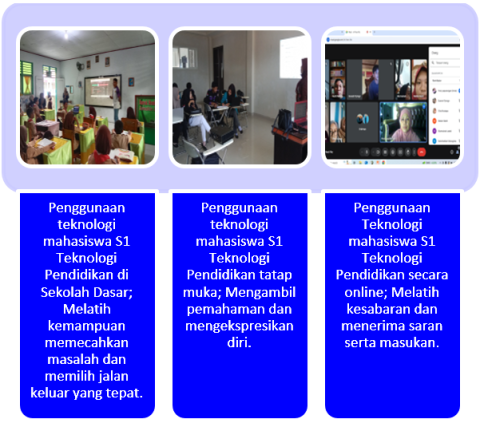
. From the results of previous research, this study further proves how the Influence of the Dynamics of Technology Use in the World of Modern Education on the Development of Adolescent Life as Students in Indonesia. The results of the study show that the dynamics of technology use in modern education can influence the development of adolescent life as students in Indonesia, the details can be seen in the following figure:
Era Octafiona's (2024)
[15]
Octafiana Era. (2024). Analisis Teknologi Pendidikan Era 4.0 dalam Menciptakan Generasi Emas Indonesia. PrimEarly, 7(1), 59-77.
research, "Analysis of Educational Technology in the 4.0 Era in Creating Indonesia's Golden Generation," provides a significant contribution, demonstrating that the use of technology not only increases learning effectiveness but also prepares the younger generation to face future challenges. In Indonesia, the importance of adopting Educational Technology is increasingly evident in efforts to create a golden generation ready to compete on the global stage. Therefore, this research reinforces the fact that the dynamics of technology use in modern education for Gen Z students can create appropriate and sustainable educational quality.
Figure 1. The Dynamic Influence of Technology Use in Modern Education on the Development of Adolescent Life as a Student in Indonesia.
The figure shows that the dynamics of technology use in modern education can influence the development of adolescent life as a student, demonstrated by the development of problem-solving skills, choosing the right solution, gaining understanding, expressing oneself, practicing patience, and accepting suggestions and input. However, the challenge faced is that the use of technology is not yet evenly distributed, resulting in a mixed quality of education in Indonesia.
From the results of an interview with one of the undergraduate students of Educational Technology with the question "How effective is the implementation of online learning?" The student (NM) answered "Actually, it is practical to save transportation costs to campus, but because of network interference, the sound is not very clear, we really have to practice patience." During face-to-face learning using technology through the presentation of material using multimedia animation media, students showed enthusiasm and were able to express themselves actively during the learning activities. This shows that the dynamics of technology use by students today need to be considered, so that it can be beneficial for the sustainability of the education they are undergoing.
5. Conclusions
This study shows that the dynamics of technology use in modern education can influence the development of the lives of adolescents as Generation Z, as demonstrated by the development of several student skills in higher education. However, the obstacle faced is the uneven use of technology, which tends to confuse the quality of education in Indonesia. Therefore, relevant research is needed so that it can be seen and implemented by all stakeholders in the world of education, particularly in Indonesia and in general throughout the world. Educational technology can change things for the better if used appropriately, but can have negative impacts if not directed, especially for students as individuals in the process of adolescent development. The positive influence of the dynamics of technology use in modern education on the development of the lives of adolescents as students in Indonesia can be created by encouraging students to utilize technology according to their needs.
While previous research focused on the use of technology in education in general, primarily to increase motivation or focus on development, this study offers innovation and updates on the dynamics of technology use in modern education among Gen Z students in Indonesia. New insights into the relationship between technology use and the characteristics of Gen Z students in various situations and conditions have significant dynamics, improving educational quality but also disrupting learning if not utilized appropriately. This new insight demonstrates that technology can be utilized and develop several basic human skills, which underpin the characteristics of Gen Z students in Indonesia.
Abbreviations
BTIKP
Center for Educational Information and Communication Technology
Agustina, R. (2018). Use of Technology in Learning. (Penggunaan Teknologi dalam Pembelajaran). Journal of Education, 12(3), 123-135.
[2]
Budiarti, S. (2021). The Digital Divide in Indonesia: Challenges and Solutions (Kesenjangan Digital di Indonesia: Tantangan dan Solusi). Technology Journal, 15(1), 45-59.
[3]
PaputunganF., & AgeS. (2023). THE USE OF DIGITAL MEDIA AND EDUCATIONAL TECHNOLOGY IN LEARNING, Frezy Paputungan, Sulastri Pua Age: THE USE OF DIGITAL MEDIA AND EDUCATIONAL TECHNOLOGY IN LEARNING, Frezy Paputungan, Sulastri Pua Age. Journal of Education and Culture (JEaC), 3(1), 1-8. Retrieved from
PaputunganF. (2023). Developmental Characteristics of Early Adulthood: Developmental Characteristics of Early Adulthood. Journal of Education and Culture (JEaC), 3(1), 47-56.
PaputunganF. (2023). STUDYING HUMAN DEVELOPMENT TO KNOW THE RIGHT LEARNING METHODS: MEMPELAJARI PERKEMBANGAN MANUSIA UNTUK MENGETAHUI METODE PEMBELAJARAN YANG TEPAT. Journal of Education and Culture (JEaC), 3(1), 87-96.
PaputunganF. (2023). EXPLORING STUDENT CHARACTERISTICS IN THE AGE OF COMMUNITY 5.0 STUDY OF THE IMPACT OF TECHNOLOGY AND DIGITALIZATION AT BINA MANDIRI UNIVERSITY GORONTALO: MENELUSURI KARAKTERISTIK MAHASISWA DI ERA MASYARAKAT 5.0 STUDI TENTANG DAMPAK TEKNOLOGI DAN DIGITALISASI DI UNIVERSITAS BINA MANDIRI GORONTALO. Journal of Education and Culture (JEaC), 3(2), 141-171.
Susanto, Ahmad. (2018). Bimbingan dan Konseling di Sekolah: Konsep, Teori, dan Aplikasinya. Jakarta: Prenadamedia Group.
[9]
PaputunganF., & OliiR. (2023). Utilization of Learning Design at the Educational Communication Information Technology Center (BTIKP) to Support the Availability of School Learning Devices in Gorontalo City. Journal of Education and Culture (JEaC), 3(2), 188-200.
Pratiwi, dkk. 2018. Pengaruh Metode Bermain dengan Bahan Bekas Terhadap Kemampuan Berhitung Anak Kelompok B usia 5-6 tahun. Jurnal PG-PAUD Trunojoyo: Jurnal Pendidikan dan Pembelajaran Anak Usia Dini. Volume 5 (1).
[11]
Rijali, Ahmad. “Analisis Data Kualitatif.”. Alhadharah: Jurnal Ilmu Dakwah17, no. 33 (2019): 84.
Halimatus Sa’diyah and Moh. Zaiful Rosyid, “Kode Etik Dan Moral Mahasiswa (Studi Terhadap Peran Tim Kode Etik Dalam Membina Moral Mahasiswa Di IAIN Madura),” NUANSA: Jurnal Penelitian Ilmu SosialDan Keagamaan Islam17, no. 1 (2020): 49,
Annisa Rizky Fadilla and Putri Ayu Wulandari, “Literature Review Analisis Data Kualitatif: Tahap Pengumpulan Data,” Mitita Jurnal Penelitian1, no. No 3 (2023): 44.
[14]
Kadhapy, M., paputungan, frezy, & B. Jassin, I. (2025). INTEGRATION OF POWTOON LEARNING MEDIA WITH THE RESPONSIBILITY OF STUDENTS IN THE GEN Z ERA. Indonesian Journal of Social Science and Education (IJOSSE), 1(3), 1164–1172.
Paputungan, F. (2026). The Influence of the Dynamics of Technology Use in the World of Modern Education on the Development of Adolescent Life as Students in Indonesia. Science Journal of Education, 14(3), 62-67. https://doi.org/10.11648/j.sjedu.20261403.13
Paputungan, F. The Influence of the Dynamics of Technology Use in the World of Modern Education on the Development of Adolescent Life as Students in Indonesia. Sci. J. Educ.2026, 14(3), 62-67. doi: 10.11648/j.sjedu.20261403.13
Paputungan F. The Influence of the Dynamics of Technology Use in the World of Modern Education on the Development of Adolescent Life as Students in Indonesia. Sci J Educ. 2026;14(3):62-67. doi: 10.11648/j.sjedu.20261403.13
@article{10.11648/j.sjedu.20261403.13,
  author = {Frezy Paputungan},
  title = {The Influence of the Dynamics of Technology Use in the World of Modern Education on the Development of Adolescent Life as Students in Indonesia},
  journal = {Science Journal of Education},
  volume = {14},
  number = {3},
  pages = {62-67},
  doi = {10.11648/j.sjedu.20261403.13},
  url = {https://doi.org/10.11648/j.sjedu.20261403.13},
  eprint = {https://article.sciencepublishinggroup.com/pdf/10.11648.j.sjedu.20261403.13},
  abstract = {Educational technology in Indonesia is undergoing a massive transformation to expand access, improve quality, and improve efficiency through e-learning platforms, blended learning, and interactive devices such as Interactive Flat Panels (IFPs). This is addressing geographic disparities by reaching remote areas. However, it faces challenges in infrastructure, teacher training, and digital literacy, requiring collaboration between the government and institutions for equitable and optimal implementation in support of the Golden Indonesia 2045 vision. Current technological developments have transformed almost all aspects of life, including education. The current learning process must adapt to the Industry 4.0 era because in this era, technology is merging to combine physical, biological, and digital dimensions, making it difficult to distinguish between them. The use of technology in education has both positive and negative impacts. Integrating technology into education can increase active student participation, facilitate broader access to information for both students and educators, and enhance students' creativity and critical thinking skills. Information and communication technology continues to develop rapidly, changing the way humans work, interact, and learn. In education, technological advances provide various resources that can expand access to knowledge, improve teaching effectiveness, and create a more interactive learning process. This technology encompasses various features such as natural language processing, machine learning, object recognition, and automation systems that are now used in various sectors of life. Students can access information more quickly, gain a personalized learning experience, and adjust the learning process to individual needs. In relation to an individual's personal life, it is a life that is whole and complete and has special or unique characteristics. A person's personal life encompasses various aspects, including emotional, socio-psychological, socio-cultural, and intellectual abilities, which are integrated with environmental factors in their life. It is viewed as a whole and complete in the form of stable behavior and actions. Thus, personal life issues are a form of integration between physical, socio-cultural, and psychological factors. An individual also needs recognition from others regarding his or her self-worth, both from his or her own family and from society. The influence of adolescence as a student, coupled with the dynamic use of technology in modern education, has proven to support student success in the educational process. However, innovation and creativity are needed from all stakeholders in Indonesia, particularly in higher education.},
 year = {2026}
}
TY  - JOUR
T1  - The Influence of the Dynamics of Technology Use in the World of Modern Education on the Development of Adolescent Life as Students in Indonesia
AU  - Frezy Paputungan
Y1  - 2026/06/04
PY  - 2026
N1  - https://doi.org/10.11648/j.sjedu.20261403.13
DO  - 10.11648/j.sjedu.20261403.13
T2  - Science Journal of Education
JF  - Science Journal of Education
JO  - Science Journal of Education
SP  - 62
EP  - 67
PB  - Science Publishing Group
SN  - 2329-0897
UR  - https://doi.org/10.11648/j.sjedu.20261403.13
AB  - Educational technology in Indonesia is undergoing a massive transformation to expand access, improve quality, and improve efficiency through e-learning platforms, blended learning, and interactive devices such as Interactive Flat Panels (IFPs). This is addressing geographic disparities by reaching remote areas. However, it faces challenges in infrastructure, teacher training, and digital literacy, requiring collaboration between the government and institutions for equitable and optimal implementation in support of the Golden Indonesia 2045 vision. Current technological developments have transformed almost all aspects of life, including education. The current learning process must adapt to the Industry 4.0 era because in this era, technology is merging to combine physical, biological, and digital dimensions, making it difficult to distinguish between them. The use of technology in education has both positive and negative impacts. Integrating technology into education can increase active student participation, facilitate broader access to information for both students and educators, and enhance students' creativity and critical thinking skills. Information and communication technology continues to develop rapidly, changing the way humans work, interact, and learn. In education, technological advances provide various resources that can expand access to knowledge, improve teaching effectiveness, and create a more interactive learning process. This technology encompasses various features such as natural language processing, machine learning, object recognition, and automation systems that are now used in various sectors of life. Students can access information more quickly, gain a personalized learning experience, and adjust the learning process to individual needs. In relation to an individual's personal life, it is a life that is whole and complete and has special or unique characteristics. A person's personal life encompasses various aspects, including emotional, socio-psychological, socio-cultural, and intellectual abilities, which are integrated with environmental factors in their life. It is viewed as a whole and complete in the form of stable behavior and actions. Thus, personal life issues are a form of integration between physical, socio-cultural, and psychological factors. An individual also needs recognition from others regarding his or her self-worth, both from his or her own family and from society. The influence of adolescence as a student, coupled with the dynamic use of technology in modern education, has proven to support student success in the educational process. However, innovation and creativity are needed from all stakeholders in Indonesia, particularly in higher education.
VL  - 14
IS  - 3
ER  -
Faculty of Education and Culture, Universitas Bina Mandiri Gorontalo, Gorontalo, Indonesia
Biography:
Frezy Paputungan is an academic and lecturer in the Educational Technology Study Program, Faculty of Education, Bina Mandiri University (UBM) Gorontalo. Her research focuses on educational technology and guidance and counseling, and her profile is indexed in SINTA. She is the author of scientific articles, such as research on the impact of MBKM project-based learning on student problem solving. She previously served as Head of the Research and Community Service Institute (LPPM) at Bina Mandiri University, Gorontalo (UBMG). She was active in research and community service development, including involvement on the team drafting the Bone Bolango regional competitiveness document and coordinating with the Gorontalo Regional Development Planning Agency (Bappeda).
Research Fields:
The Developmental Influence of Adolescent Life; The Right Learning Method for Human Development; Technology Integration in Technical Implementation of Kdmp; The Concept of Individualization in 4.0 Era Students; Application of Quantum Teaching Method; Implementation of KKN as Community Service Activities; MBKM Project-Based Learning on Problem Solving.
Paputungan, F. (2026). The Influence of the Dynamics of Technology Use in the World of Modern Education on the Development of Adolescent Life as Students in Indonesia. Science Journal of Education, 14(3), 62-67. https://doi.org/10.11648/j.sjedu.20261403.13
Paputungan, F. The Influence of the Dynamics of Technology Use in the World of Modern Education on the Development of Adolescent Life as Students in Indonesia. Sci. J. Educ.2026, 14(3), 62-67. doi: 10.11648/j.sjedu.20261403.13
Paputungan F. The Influence of the Dynamics of Technology Use in the World of Modern Education on the Development of Adolescent Life as Students in Indonesia. Sci J Educ. 2026;14(3):62-67. doi: 10.11648/j.sjedu.20261403.13
@article{10.11648/j.sjedu.20261403.13,
  author = {Frezy Paputungan},
  title = {The Influence of the Dynamics of Technology Use in the World of Modern Education on the Development of Adolescent Life as Students in Indonesia},
  journal = {Science Journal of Education},
  volume = {14},
  number = {3},
  pages = {62-67},
  doi = {10.11648/j.sjedu.20261403.13},
  url = {https://doi.org/10.11648/j.sjedu.20261403.13},
  eprint = {https://article.sciencepublishinggroup.com/pdf/10.11648.j.sjedu.20261403.13},
  abstract = {Educational technology in Indonesia is undergoing a massive transformation to expand access, improve quality, and improve efficiency through e-learning platforms, blended learning, and interactive devices such as Interactive Flat Panels (IFPs). This is addressing geographic disparities by reaching remote areas. However, it faces challenges in infrastructure, teacher training, and digital literacy, requiring collaboration between the government and institutions for equitable and optimal implementation in support of the Golden Indonesia 2045 vision. Current technological developments have transformed almost all aspects of life, including education. The current learning process must adapt to the Industry 4.0 era because in this era, technology is merging to combine physical, biological, and digital dimensions, making it difficult to distinguish between them. The use of technology in education has both positive and negative impacts. Integrating technology into education can increase active student participation, facilitate broader access to information for both students and educators, and enhance students' creativity and critical thinking skills. Information and communication technology continues to develop rapidly, changing the way humans work, interact, and learn. In education, technological advances provide various resources that can expand access to knowledge, improve teaching effectiveness, and create a more interactive learning process. This technology encompasses various features such as natural language processing, machine learning, object recognition, and automation systems that are now used in various sectors of life. Students can access information more quickly, gain a personalized learning experience, and adjust the learning process to individual needs. In relation to an individual's personal life, it is a life that is whole and complete and has special or unique characteristics. A person's personal life encompasses various aspects, including emotional, socio-psychological, socio-cultural, and intellectual abilities, which are integrated with environmental factors in their life. It is viewed as a whole and complete in the form of stable behavior and actions. Thus, personal life issues are a form of integration between physical, socio-cultural, and psychological factors. An individual also needs recognition from others regarding his or her self-worth, both from his or her own family and from society. The influence of adolescence as a student, coupled with the dynamic use of technology in modern education, has proven to support student success in the educational process. However, innovation and creativity are needed from all stakeholders in Indonesia, particularly in higher education.},
 year = {2026}
}
TY  - JOUR
T1  - The Influence of the Dynamics of Technology Use in the World of Modern Education on the Development of Adolescent Life as Students in Indonesia
AU  - Frezy Paputungan
Y1  - 2026/06/04
PY  - 2026
N1  - https://doi.org/10.11648/j.sjedu.20261403.13
DO  - 10.11648/j.sjedu.20261403.13
T2  - Science Journal of Education
JF  - Science Journal of Education
JO  - Science Journal of Education
SP  - 62
EP  - 67
PB  - Science Publishing Group
SN  - 2329-0897
UR  - https://doi.org/10.11648/j.sjedu.20261403.13
AB  - Educational technology in Indonesia is undergoing a massive transformation to expand access, improve quality, and improve efficiency through e-learning platforms, blended learning, and interactive devices such as Interactive Flat Panels (IFPs). This is addressing geographic disparities by reaching remote areas. However, it faces challenges in infrastructure, teacher training, and digital literacy, requiring collaboration between the government and institutions for equitable and optimal implementation in support of the Golden Indonesia 2045 vision. Current technological developments have transformed almost all aspects of life, including education. The current learning process must adapt to the Industry 4.0 era because in this era, technology is merging to combine physical, biological, and digital dimensions, making it difficult to distinguish between them. The use of technology in education has both positive and negative impacts. Integrating technology into education can increase active student participation, facilitate broader access to information for both students and educators, and enhance students' creativity and critical thinking skills. Information and communication technology continues to develop rapidly, changing the way humans work, interact, and learn. In education, technological advances provide various resources that can expand access to knowledge, improve teaching effectiveness, and create a more interactive learning process. This technology encompasses various features such as natural language processing, machine learning, object recognition, and automation systems that are now used in various sectors of life. Students can access information more quickly, gain a personalized learning experience, and adjust the learning process to individual needs. In relation to an individual's personal life, it is a life that is whole and complete and has special or unique characteristics. A person's personal life encompasses various aspects, including emotional, socio-psychological, socio-cultural, and intellectual abilities, which are integrated with environmental factors in their life. It is viewed as a whole and complete in the form of stable behavior and actions. Thus, personal life issues are a form of integration between physical, socio-cultural, and psychological factors. An individual also needs recognition from others regarding his or her self-worth, both from his or her own family and from society. The influence of adolescence as a student, coupled with the dynamic use of technology in modern education, has proven to support student success in the educational process. However, innovation and creativity are needed from all stakeholders in Indonesia, particularly in higher education.
VL  - 14
IS  - 3
ER  -






 Share This Article
 Twitter
 Linked In
 Facebook
 Copy
Copy Download